
Shopping Cart







Building a mining stock portfolio that consistently delivers strong risk-adjusted returns requires more than picking a few promising names — it demands a coherent, disciplined strategy that accounts for commodity cycles, company-specific risk, position sizing, sector diversification, and long-term wealth objectives. Mining stocks are among the most volatile and operationally complex investments available to retail investors, and without a strategic framework, even fundamentally sound investment ideas can result in poor outcomes due to bad timing, poor position management, or inadequate diversification. At GoldMiner.fr, our actively managed portfolio — which has tracked approximately 30% annual returns — is built on exactly this kind of rigorous, disciplined approach, and this pillar shares that framework with investors at every level of experience.
The Architecture of a Well-Structured Mining Stock Portfolio
A well-constructed mining stock portfolio has an intentional architecture that balances risk and reward across multiple dimensions. At the foundation sit major producers — established, well-capitalised companies like senior gold and silver miners — that provide stable core exposure to metal prices with relatively low operational risk. The next layer consists of mid-tier and emerging producers, which offer higher growth potential and greater sensitivity to rising metal prices, at the cost of higher operational and balance sheet risk. At the high-risk, high-reward apex of the portfolio sit junior explorers and developers — small companies where a significant discovery or development success can multiply investment capital several times over. The proportions allocated to each tier depend on the investor's risk tolerance, market cycle positioning, and investment timeline, but a typical balanced structure might allocate roughly 50% to seniors, 30% to mid-tiers, and 20% to juniors.
Diversifying Across Metals and Geographies
Effective mining portfolio diversification operates across multiple dimensions beyond company size. Diversification across metals — gold, silver, copper, uranium, and other commodities — reduces reliance on any single commodity cycle and allows a portfolio to benefit from different macro environments. A portfolio tilted toward gold and silver performs best in periods of monetary instability and inflation; copper and other base metals provide stronger returns during periods of industrial growth; uranium benefits from energy policy shifts and nuclear capacity expansion. Geographic diversification — holding companies operating in multiple mining jurisdictions including Canada, Australia, North America, Latin America, and select parts of Africa — reduces the impact of adverse regulatory or political developments in any single region. At GoldMiner.fr, our portfolio integrates all of these diversification dimensions within a coherent strategic framework.
Timing Mining Stock Cycles: Entry, Hold, and Exit Strategy
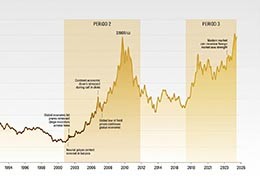
Timing is more important in mining stocks than in most other investment categories, due to the sector's extreme cyclicality. The best time to build mining stock positions is typically during sector bear markets — periods of depressed metal prices, investor neglect, and widespread pessimism about the outlook for commodities. This is exactly when fundamentally strong companies trade at the most compelling valuations relative to their intrinsic asset value. Conversely, the time to reduce exposure is typically during the later stages of bull markets, when valuations have expanded dramatically, speculative activity is elevated, and the macro conditions that supported the bull cycle are beginning to shift. At GoldMiner.fr, our cycle awareness — informed by nearly two decades of observing full commodity cycles — informs every portfolio allocation decision, helping investors enter positions when risk-reward is most favorable and exit before the inevitable cycle turns.
Risk Management: Position Sizing, Stop Losses, and Portfolio Limits
In a sector as volatile as mining stocks, risk management is not optional — it is the foundation upon which all returns are built. Proper position sizing ensures that no single stock failure, however unexpected, can catastrophically impair the overall portfolio. For junior mining positions, where binary outcomes are common, position sizes of 1–3% of total portfolio value are typical among experienced investors. For larger, more established producers, positions of 5–10% can be appropriate. Stop-loss discipline — defining in advance at what point a losing position will be exited — prevents the common investor mistake of holding declining positions in the hope of recovery while other, better opportunities go unallocated. Portfolio-level monitoring of total sector exposure, total leverage, and geographic concentration ensures that diversification benefits are maintained even as individual positions evolve.
Long-Term Mining Stock Investing: Building Wealth Through Full Cycles
The most successful mining stock investors are those who take a long-term, full-cycle perspective — understanding that periods of underperformance and skepticism are as much a part of the opportunity as the bull markets themselves. Building quality positions during periods of pessimism, holding through the inevitable volatility of mid-cycle corrections, and maintaining conviction based on fundamental analysis rather than short-term price action are the hallmarks of investors who compound wealth successfully in this sector. At GoldMiner.fr, our investment philosophy is explicitly long-term and cycle-aware: we seek to identify the companies best positioned to deliver exceptional returns over a full commodity cycle, build positions with appropriate diversification and risk management, and share our analysis and reasoning with full transparency so that our subscribers can learn, evaluate, and invest with genuine confidence.